
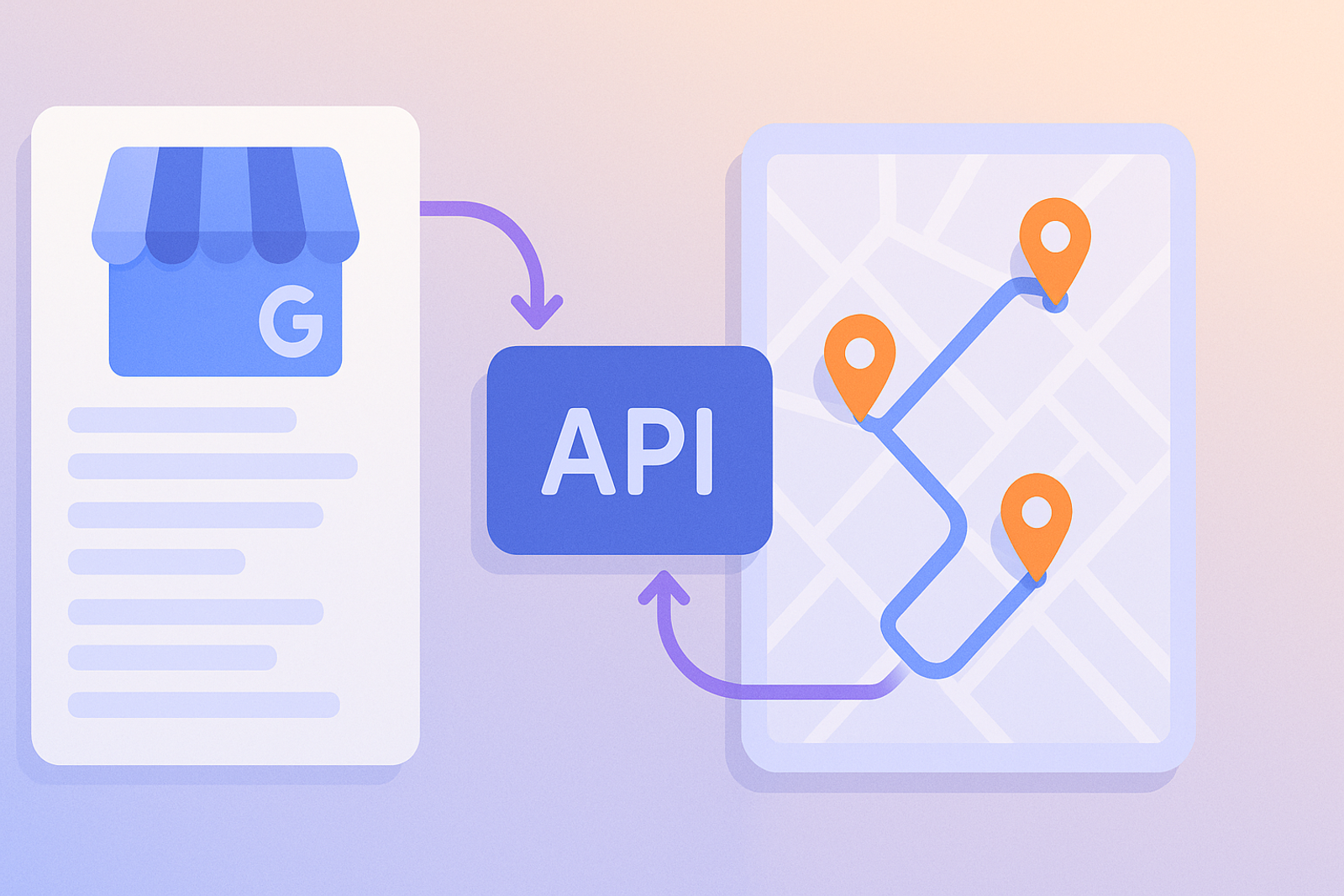
If you manage multiple listings on Google Maps, sooner or later you come to the same conclusion: doing it from the official panel does not scale. This is where the Google Business Profile API — previously known as the Google My Business API or simply the Google My Business platform — comes in, along with tools like Mapgrid, which leverage that API to give you real control over dozens or hundreds of locations.
What is the Google Business Profile API?
The Google Business Profile API is Google's official interface for programmatically reading and modifying a business listing's information: name, address, phone number, hours, categories, attributes, photos, posts, reviews, and performance metrics. In practice, it allows external software to do the same things you would do manually at business.google.com, but multiplied across hundreds of locations and without opening a browser.
In 2021, Google rebranded the product: what was called Google My Business (GMB) became Google Business Profile (GBP). The API also changed its name — from Google My Business API to Google Business Profile API — and was divided into several smaller APIs: Business Information, Account Management, My Business Verifications, My Business Notifications, My Business Business Information Performance, and My Business Q&A. The monolithic v4 endpoint is still alive for posts, media, and reviews, but is classified as legacy.
From Google My Business platform to Google Business Profile API
Many teams are still searching Google for terms like "Google My Business API" or "Google My Business platform" because that’s what it was called for years. Today, these terms are colloquial synonyms for the same thing, but it's important to understand how the ecosystem is divided:
- Business Information API: read and update the basic information of each listing (address, category, hours, attributes).
- Account Management API: accounts, groups, and managers.
- Verifications API: initiate and complete verification via postal mail, phone, email, or video.
- Performance API: impressions, searches, calls, directions, and clicks to the website.
- v4 (legacy): posts, photos, and reviews.
All of this operates on OAuth 2.0 with the scope business.manage. Without the scope, without an approved Google Cloud project, and without a quota granted by Google, the API simply does not respond to write operations.
The real friction of working with the API
On paper, the API seems complete. In a real project, these are the walls teams encounter:
- Restricted access: Google requires filling out a form and getting project approval before granting useful quotas. Without that extended access, the default QPS remains in single digits.
- Distributed endpoints: publishing an offer, responding to a review, and updating hours requires interacting with three different APIs, each with its own version, format, and behavior regarding 5xx errors.
- Expiring tokens: the access_token lasts 60 minutes. Without a well-stored refresh_token and a silent renewal logic, any background process fails every hour.
- Changes without notice: in recent years, Google has deprecated the creation of OFFER posts via API, changed the verification flow, and migrated features from the v4 legacy to v1. An integrator must keep track of the changelog.
- Scale: importing 500+ locations from an account requires pagination, backoff, retries, and — beyond a certain volume — alternative flows because the official API does not list everything in a single pass.
How Mapgrid turns the API into a usable platform
Mapgrid is built directly on top of the official Google Business Profile API. It is not a scraper or an opaque intermediary: it uses the same APIs, with OAuth business.manage, and adds the layer that the API alone does not offer.
- One-click onboarding: connect your Google account and Mapgrid imports all locations, including large accounts with over 500 listings, through a Playground flow that bypasses listing limits.
- Real bulk editing: change hours, categories, attributes, or descriptions across dozens of listings at once from a single table, with prior validation and atomic push to Google.
- Automatic NAP audit: Mapgrid compares name, address, and phone number between your local database and Google, allowing you to push corrections to the right side with one click.
- Historical analytics: the Performance API only returns recent data. Mapgrid moves this data to BigQuery and provides complete series from July 2024 with filters for 7/14 days, current month, previous month, and custom windows.
- Scheduled posts: create UPDATE or EVENT posts and schedule them. Mapgrid publishes them via API when appropriate and retries in case of transient 500 errors from Google.
- Centralized reviews: all reviews from all listings in a single inbox, with sentiment analysis and direct response via API.
- Silent token renewal: the refresh_token is managed on the server. Your team will never see a "reconnect your account" screen in the middle of a campaign.
When does it make sense to integrate with the API yourself?
Integrating the Google Business Profile API on your own makes sense if you are going to build a product to sell to third parties, if your internal ERP needs to synchronize hours in a very specific way, or if your team dedicates full-time engineering to this. In any other scenario — a chain, a franchise, a local marketing agency, an e-commerce with physical stores — the return on maintaining that integration in-house is negative compared to using a platform that has already absorbed all those bumps.
Real use cases
- A pharmacy chain with 150 branches that unifies holiday hours in 3 minutes instead of 3 days.
- A restaurant franchise that schedules a weekly EVENT post for each location from a template.
- A local SEO agency that audits the NAP of 40 clients and bills the correction as a recurring service.
- A retailer that exports Performance API metrics to its own BI dashboard via the BigQuery mirror.
Get started with Mapgrid
The Google Business Profile API is powerful but raw. Mapgrid transforms that power into a platform that a marketing or operations team can use without writing a line of code. You can start today from our plans and connect your Google account in less than two minutes.